

Leadership apprenticeships in 2026: what’s being defunded, what’s replacing it, and what employers need to do before September

img_2

From 1 September 2026, the UK government is withdrawing levy funding from sixteen apprenticeship standards. Three of them sit at the centre of how thousands of organisations have developed their managers for the past decade: Team Leader, Operations Manager, and Coaching Professional. If your organisation has built any part of its leadership pipeline on these standards, the relevant question is no longer whether the change affects you. It is how to think clearly about what comes next.

This article sets out what is changing, what happens to the people already on programme, and how the wider levy reforms shorten your planning window. It then offers a framework for working through your replacement options, whichever provider you eventually choose. The aim is to give you the clarity to make a good decision, not to push you towards a particular one.

What is being defunded and why

Skills England, working through the Department for Work and Pensions, has confirmed that sixteen apprenticeship standards will lose funding for new starts from 1 September 2026 (gov.uk apprenticeship funding rules). Three of them are leadership and management standards that have anchored employer-commissioned development for the past decade: Team Leader and Supervisor (Level 3), the most widely used management apprenticeship in the country; Operations and Departmental Manager (Level 5), the standard middle managers have used to reach CMI Level 5; and Coaching Professional (Level 5), the route many organisations have used to build internal coaching capability. The Chartered Manager Degree Apprenticeship at Level 6 has been withdrawn in the same package.

The scale of the disruption is easiest to see through the Team Leader standard alone. It recorded 12,670 starts in 2024 to 2025 across roughly 450 training providers, which makes it the most popular apprenticeship in the country to lose funding, and of those starters only 80 were aged under 19 (FE Week, March 2026). That imbalance is the heart of the government’s rationale: these standards have grown into continuing professional development for staff aged 25 and over, rather than an entry route into skilled work for younger people. Funding is being redirected towards younger learners and towards the skills named in the industrial strategy, primarily AI, digital, and technical capability. The shift follows a long decline in apprenticeship starts among young people over the past decade, which the government is trying to reverse (Instep, March 2026).

The three leadership standards are the part of the package most organisations will feel, but they are not the whole of it. The remaining thirteen withdrawn standards sit outside management, across areas such as improvement, compliance, and care (FE Week, March 2026). If you run apprentices in any of those areas, it is worth checking the full list against your current cohorts.

The response from employers and professional bodies has been direct. The British Chambers of Commerce warned that further restrictions on management and leadership apprenticeships would damage business confidence. The Chartered Management Institute has pointed to its own data showing management apprenticeships contributed £119.5 million to GDP in a single year. The policy stands regardless. The organisations that handle the transition best will be the ones that treat it as a prompt to think more deliberately about the leaders they are developing, rather than only as a funding gap to plug.

The three defunded leadership standards are:

  • Team Leader / Supervisor (Level 3) – the most widely used management apprenticeship in the UK, designed for first-line managers and newly promoted team leaders.
  • Operations / Departmental Manager (Level 5) – for middle managers with responsibility for teams, projects, or functions, and the primary route to CMI Level 5 accreditation through apprenticeship funding.
  • Coaching Professional (Level 5) – for professionals developing formal coaching capability alongside their management or leadership role.

The Chartered Manager Degree Apprenticeship at Level 6 has also been defunded as part of the same package of changes.

The risk for many organisations is not simply the loss of funding, but the long-term impact on leadership pipelines, workplace confidence, succession planning and the development of managers expected to lead increasingly complex teams.  These are not abstract concerns.  They are the practical consequences of removing structured, funded development from the people organisations rely on the most.

What happens to learners already on these programmes

A man and a woman in the countryside reading a map next to a car.

The first question most HR and L&D teams ask is what happens to people already on these programmes, and the answer is reassuring. Any apprentice who starts a defunded standard before 1 September 2026 can continue to completion under their existing funding. The withdrawal applies to new starts only. Your current Team Leader and Operations Manager apprentices are protected. Your pipeline beyond the September cut-off is not.

What this means in practice is that your current Team Leader or Operations Manager apprentices are protected. Your pipeline beyond the September cut-off is not.

One point on timing matters more than the headline date. The realistic deadline for new starts on these standards is closer to June 2026 than September. Apprenticeship agreements and individual learning plans take time to put in place, and a cohort begun in late August in the hope of beating the deadline carries real administrative risk. If you are considering any final starts on a defunded standard, the window is effectively now.

One thing to avoid: do not start a cohort in summer 2026 expecting to re-enrol the same people under the same standard in the autumn. Once a standard is defunded, new starts under it are not permitted. A replacement standard may appear in time, although it will be a different standard, with a different funding band and its own approval timeline.
The levy timing decisions your organisation needs to make now

The defunding lands at the same time as a set of broader levy changes that tighten the financial planning rather than ease it. From the start of the 2026 to 2027 funding year on 1 August 2026, three changes take effect together. The levy expiry window shortens from twenty-four months to twelve, so unspent funds in your apprenticeship service account will expire faster than previously planned. The government’s ten per cent top-up on levy funds is removed. And the co-investment rate for employers who exhaust their levy funds rises from five per cent to twenty-five per cent, which raises the cost of any apprenticeship training above your levy balance (HM Treasury, Budget 2025; CIPD, January 2026).

The picture differs for smaller employers. From the same date, small and medium organisations that do not pay the levy receive full government funding for apprentices aged under 25, which removes their co-investment for that group (HM Treasury, Budget 2025). The constraint that bites hardest falls on large levy payers with balances they now have less time to spend.

For large employers with unspent levy balances, these changes create a compounded pressure: the window for spending accumulated funds is shortening at exactly the moment when the leadership apprenticeships those funds were earmarked for are being withdrawn. The organisations that navigate this well are those that identify their unspent balance, map it against the funded alternatives that do exist, and make enrolment decisions before the August changes take effect.

The practical planning sequence is straightforward. First, confirm your current apprenticeship service account balance and the expiry dates of the funds within it. Second, identify which of the funded alternatives below are relevant to your leadership development needs. Third, open conversations with a provider now rather than in late summer, when capacity across the sector will be under pressure.

What happens to learners already on these programmes

The first question most HR and L&D teams ask is what happens to people already on these programmes, and the answer is reassuring. Any apprentice who starts a defunded standard before 1 September 2026 can continue to completion under their existing funding. The withdrawal applies to new starts only. Your current Team Leader and Operations Manager apprentices are protected. Your pipeline beyond the September cut-off is not.

One point on timing matters more than the headline date. The realistic deadline for new starts on these standards is closer to June 2026 than September. Apprenticeship agreements and individual learning plans take time to put in place, and a cohort begun in late August in the hope of beating the deadline carries real administrative risk. If you are considering any final starts on a defunded standard, the window is effectively now.

One thing to avoid: do not start a cohort in summer 2026 expecting to re-enrol the same people under the same standard in the autumn. Once a standard is defunded, new starts under it are not permitted. A replacement standard may appear in time, although it will be a different standard, with a different funding band and its own approval timeline.

What replaces them: two funded alternatives worth considering

The government’s decision to defund leadership and management apprenticeships is not a statement about the value of leadership development. It is a funding policy decision. The development needs at Team Leader and Operations Manager levels do not disappear in September. What changes is the mechanism through which it can be funded.

Within the apprenticeship system, two standards are particularly relevant for organisations whose leadership development plans have been disrupted by the defunding. Both carry levy funding into 2026 and beyond. Both have substantive overlap with the management and leadership capabilities that the defunded standards were designed to develop. And both are available through Aicura.

It is worth being direct about what these programmes are and what they are not. Neither is a like-for-like replacement for the Team Leader or Operations Manager standard in terms of content or career positioning. What they do share is a commitment to developing people who can navigate complexity, support others through change, and lead with operational awareness as well as technical capability, which, in our experience, is what organisations most need from their emerging leaders right now. They are different programmes designed for a partly overlapping audience. The question for each organisation is not ‘which standard is most similar to what we had?’ but ‘which standard best serves our leadership development needs within the current funding landscape?’

For some organisations, the answer will be one of these two standards. For others, direct-funded CMI delivery outside the apprenticeship system will be the more appropriate route, particularly for senior cohorts at Level 6 and Level 7 where apprenticeship standards no longer carry funding, or for organisations that want the flexibility of a non-apprenticeship programme design. Those two routes are not mutually exclusive, and a well-structured leadership development architecture for a large organisation will often use both.

The direct-funded route: CMI qualifications outside the apprenticeship system

The apprenticeship system is one mechanism for funding leadership development, but not the only one. CMI qualifications from Level 3 to Level 7 remain available on a direct-funded basis, where the organisation commissions and funds the programme directly with a CMI Strategic Delivery Partner rather than drawing on the Levy.

The qualification framework, the CMI accreditation, the assessment rigour, and the pathway to Chartered Manager status are all identical to the apprenticeship route. What changes is the absence of the apprenticeship wrapper, the off-the-job training requirements, the endpoint assessment structure, and the administrative compliance framework that apprenticeship delivery requires. For many organisations, that simplification is itself a benefit: direct-funded CMI programmes can be designed more flexibly, started more quickly, and structured more precisely around the organisation’s specific leadership development priorities.

For large organisations whose levy balance is sufficient to fund apprenticeship starts on the Associate Project Manager or AI Practitioner standards, a combined approach is often the most practical: levy-funded apprenticeship delivery for the populations where those standards fit, and direct-funded CMI delivery for cohorts typically at senior manager and director level, where the apprenticeship framework may not be appropriate.

A framework for thinking through your options before September

The defunding removes a funding mechanism, not the development need. Your managers still need to be developed in September. What changes is how that development can be paid for and structured. Broadly, four options are open to most organisations, and many will use more than one.

Continue with your existing provider on a different, still-funded standard.

If your current provider delivers a funded standard that develops adjacent capabilities, the simplest path may be to keep the relationship and change the programme. You preserve continuity of delivery and the account knowledge your provider has already built up.

Switch to a different funded apprenticeship standard.

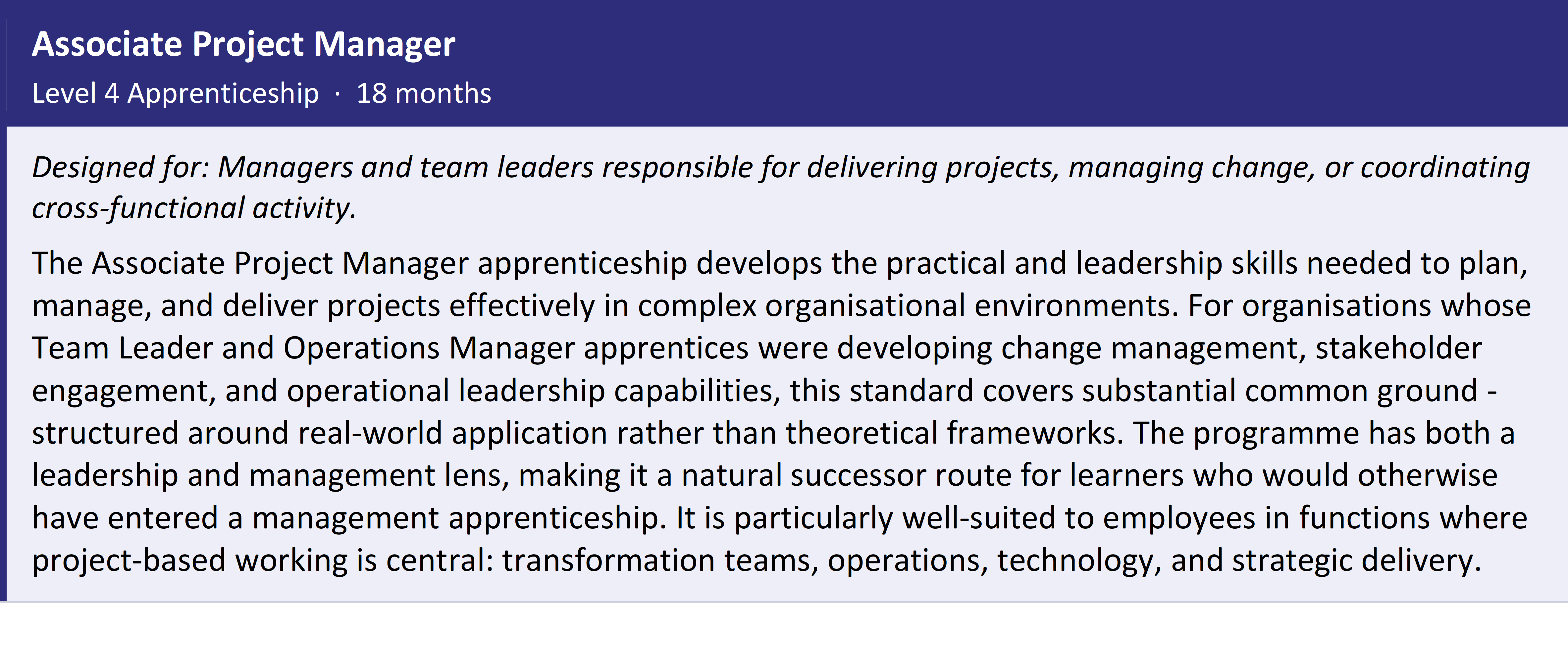
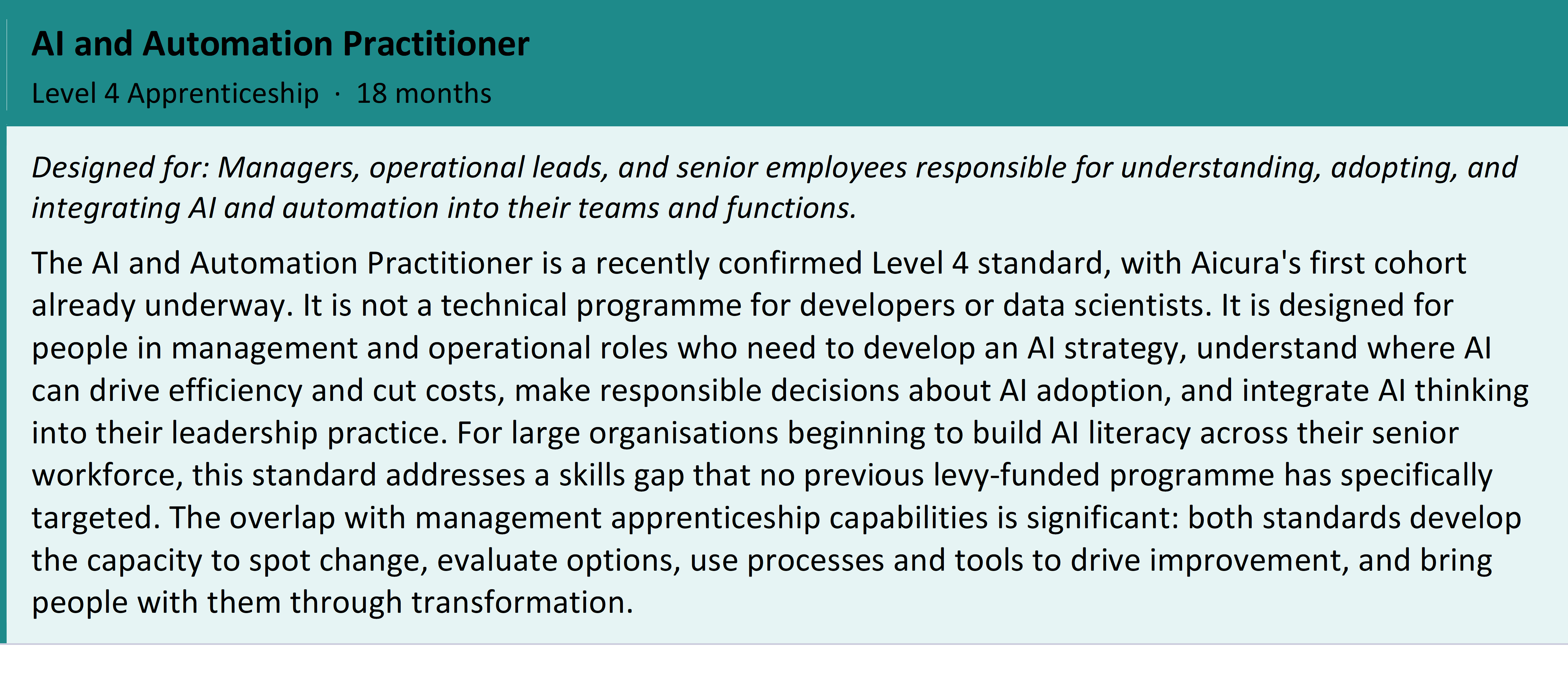
Several standards that develop management-adjacent capability remain funded into 2026 and beyond. Two that organisations are looking at closely are the Associate Project Manager (Level 4) and the AI Practitioner, formally the AI and Automation Practitioner (Level 4). Neither is a like-for-like swap for Team Leader or Operations Manager in content or career positioning. What they share is a focus on developing people who can navigate complexity, lead through change, and combine operational awareness with technical capability. The useful question is less about which standard most resembles what you had, and more about which best serves your development needs within the funding that now exists.

Move some development outside the apprenticeship system.

Direct-funded routes, where you commission and pay for a programme without drawing on the levy, remain fully available. CMI and ILM qualifications from Level 3 to Level 7 can be delivered this way, with the same accreditation, assessment rigour, and progression to Chartered Manager status. What you give up is the levy subsidy. What you gain is flexibility, faster start dates, and a programme shaped around your priorities without the off-the-job training and end-point assessment that apprenticeships require. For senior cohorts at Level 6 and Level 7, where apprenticeship funding has already gone, this is often the only viable route.

Combine the two.

For larger organisations, the most practical architecture is frequently a blend: levy-funded apprenticeships for the populations where a funded standard fits, and direct-funded provision for the cohorts where it does not. This lets you spend your levy balance where it works hardest and fund the rest deliberately. In practice it often means mapping each part of your management population to the route that funds it best, rather than forcing the whole group down a single path.

Alongside these routes, the reformed levy is opening up newer, more flexible provision: foundation apprenticeships aimed at younger entrants, and shorter modular “apprenticeship units”, with the first units concentrated on priority skills including AI (BPIF, April 2026). These will not replace a full management apprenticeship, although they may be useful for targeted upskilling within a wider plan.

Whichever direction you take, three questions will sharpen the decision before you speak to any provider.


Which defunded standards were central to your leadership pipeline, and at what volume?

An organisation running 50 Team Leader apprentices a year faces a different planning challenge than one running five. The volume determines whether a like-for-like funded replacement is commercially viable and whether your unspent levy balance is sufficient to sustain it.

What does your leadership pipeline look like beyond your current enrolled cohorts?

If your pipeline of future Team Leader or Operations Manager candidates is already identified, the urgency of finding a replacement route is high. If the pipeline is less defined, the September deadline creates an opportunity to redesign your leadership development architecture rather than simply replace a funding mechanism.

What is your unspent levy position and what is the expiry profile of those funds?

With the expiry window reducing to 12 months from August, funds that were not previously at risk of expiry now are. Mapping your balance against the available funded programmes before August is a financial planning decision as much as an L&D one.

Talk to Aicura about your leadership development options before September

Everything above applies whichever provider you choose. For completeness, here is what Aicura offers against that landscape.

Aicura is a CMI Strategic Delivery Partner and delivers both levy-funded apprenticeships and direct-funded CMI qualifications from Level 3 to Level 7, which means it can support more than one of the options above within a single conversation. It currently has capacity on the Associate Project Manager (Level 4) and AI and Automation Practitioner (Level 4) apprenticeships and is accepting enrolments now. For senior cohorts where apprenticeship funding no longer applies, it delivers CMI programmes on a direct-funded basis.

What distinguishes Aicura’s delivery is its emphasis on the individual’s development as a leader, supported by a dedicated personal skills coach throughout the programme, alongside the C30 framework that structures development across thirty capabilities mapped to career stage. Most management training concentrates on what a manager does. Aicura’s programmes concentrate on who a manager is becoming.

For large organisations with a structured leadership pipeline that the defunding has disrupted, we work through the options with you, not from a single standard or a single programme type, but from a genuine understanding of your management population, your levy position, and the development outcomes you need to sustain. At Aicura, the focus has never simply been qualification delivery, but developing reflective, operationally aware leaders capable of supporting people through complexity and change. Every programme we deliver is built around the individual learner’s journey and identity as a leader, supported by a dedicated personal skills coach throughout.

If your leadership pipeline includes Team Leader, Operations Manager, or Coaching Professional cohorts affected by the September change, the time to map your options is now, ahead of the late-summer pressure on provider capacity.

Speak to Aicura about your leadership development options

We are accepting enrolments now for the Associate Project Manager and AI and Automation Practitioner apprenticeships, and for direct-funded CMI programmes at Level 3 to Level 7. Get in touch to discuss your organisation’s specific requirements and timeline.

www.aicura.com/contact