

18 Sep How to spot an accidental manager on your team
We recently wrote about the accidental manager problem, the fact that most people who end up managing others in the UK were never taught how, and what that costs the organisations who promote them anyway. That post made the business case. This one is about something more immediate: what the accidental manager problem actually looks like inside a team, before it shows up in an exit interview or a productivity report.

The pattern repeats across very different kinds of work. A technically brilliant developer becomes a team lead because the promotion comes with better pay and more standing, not because anyone has assessed whether they can manage people. A university department head is appointed for academic standing, then finds themselves running budgets, performance reviews and staff conflicts they were never trained for. The specifics change by sector, the underlying failure doesn’t: the organisation promotes on the strength of one skill set and assumes a second, entirely different one will simply follow.
If you manage people, or you manage people who manage others, the patterns below are worth checking against your own experience. None of them are character flaws. They are what happens, predictably and consistently, when someone capable is put in charge of people with no structured preparation for the part of the job that has nothing to do with the skill that got them promoted. Every one of them is also easier, and considerably cheaper, to address before it escalates than after, which is exactly why they’re worth recognising now rather than waiting for an engagement survey, an exit interview or a resignation to point them out for you.
They avoid the conversation that needs having
It rarely announces itself as avoidance. It looks like a one-to-one that runs late and gets rescheduled, then rescheduled again. It looks like feedback delivered so gently that the message underneath it disappears, a performance issue described as “something to keep an eye on” rather than named for what it is. It looks like a manager who will talk to you about anything except the thing that actually needs addressing, because naming it means dealing with whatever comes next, the reaction, the awkwardness, the risk of getting it wrong. So the conversation gets deferred, and the underlying issue, whether it’s underperformance, friction between two team members, or a promise that can’t be kept, doesn’t go away. It just gets harder to raise the longer it’s left.

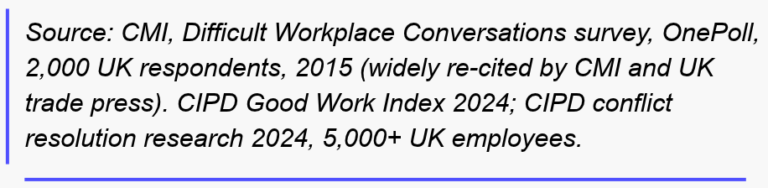
This isn’t a confidence problem in the way it’s usually described. It’s a skills gap, and it’s a common one. CMI research found that 57% of respondents said they would do almost anything to avoid a difficult conversation, and 52% said they would rather put up with a negative situation at work than address it directly. The consequence of that avoidance shows up clearly in CIPD’s more recent data: the CIPD’s Good Work Index 2024 found that a quarter of employees experienced some form of workplace conflict in the previous year, and separate CIPD research from 2024, based on a survey of over 5,000 employees, found that only 36% of those who experienced conflict felt it had been fully resolved. Put together, the two figures describe the same failure from two angles: managers avoid the conversation, and when conflict happens anyway, most of it doesn’t get properly resolved either.
What formal training gives someone here isn’t courage, courage isn’t really the missing ingredient. It’s structure: a clear model for how to open a difficult conversation, how to stay focused on the issue rather than the emotion in the room, and how to close it with something that actually changes, rather than a vague sense that the air has been cleared.
Part of that structure is a shift in the question being asked. Traditional feedback asks what went wrong, and who’s responsible for it, which is precisely the framing that makes the conversation worth avoiding in the first place. Feedforward asks something different: what will you do differently next time? That’s a smaller, more specific question, and a considerably easier one for an undertrained manager to open with, because it points towards a next step rather than towards blame.
That structure is exactly what someone promoted on technical or sales strength was never given, and exactly what experience alone, however many years of it, doesn’t reliably teach.
They won’t let go of the work
The signs are easy to miss because they look like diligence. The manager who’s still doing the technical work themselves rather than handing it to the team they were hired to lead. The one who reviews everything before it goes out, not because the standard requires it, but because they don’t quite trust anyone else to meet it. The one who says yes to delegating in principle, then finds a reason each week why this particular task isn’t quite ready to hand off. From the outside it can look like commitment. From inside the team, it looks like a manager who hasn’t actually stepped into the role they were promoted into, and a group of people who were hired to do the job but rarely get the chance to own it.

This is one of the clearest and most consistent gaps in the data. DDI’s Global Leadership Forecast 2025, based on insights from over 10,000 leaders worldwide, found that only 19% of managers report having strong delegation skills. DDI connects this directly to burnout, not as an abstract wellbeing concern, but as a structural one: a manager who won’t delegate ends up carrying a workload built for two roles, technical contributor and people manager, while the team underneath them stays underused and, eventually, disengaged.

What training addresses here is rarely willpower, most of these managers know, in principle, that they should be delegating more. What’s missing is a working framework for deciding what to hand off and when, how to brief a task properly so the outcome doesn’t depend on the manager checking it personally, and how to tolerate a result that’s different from how they’d have done it themselves without treating that difference as a failure. None of that is instinctive. It’s teachable, and it’s one of the more immediate, practical differences a formal programme makes, because unlike some management skills, the change in behaviour is visible within weeks rather than months.
Their team’s problems become their problems, too late
This one is the hardest to spot from the outside, because by the time it’s visible, it’s usually already a problem. A team member who’s been quietly struggling for weeks, and whose manager only registers it when the absence request comes in. A drop in someone’s usual standard of work that gets read as a lapse in effort rather than a signal that something’s wrong. A manager who genuinely cares about their team, and would want to help if they recognised what they were looking at, but who has never been shown what the early signs actually look like, or how to raise what they’ve noticed without it feeling like an accusation.

This is a training gap in the most literal sense, and CIPD’s most recent data makes the size of it clear. CIPD’s Health and Wellbeing at Work 2025 report, based on a survey of over 1,100 UK employers, found that only 29% of organisations train line managers to support mental health. The gap that training closes is measurable rather than assumed: 73% of employers who do train their managers agree that managers are confident to have sensitive discussions and signpost staff to expert sources of help, compared with just 57% of those who don’t offer training. That’s not a small difference. It’s the gap between a manager who notices something is wrong and knows what to do next, and one who notices, and hesitates, or doesn’t notice at all.

What this section is really about is prevention rather than response. A manager equipped to spot the early signs can raise a conversation while there’s still room to adjust workload, offer support, or simply ask the right question before things escalate. A manager who isn’t finds out there’s a problem only once it’s already become one, an absence, a resignation, or a situation that’s moved beyond anything an informal conversation can fix. The skill isn’t complicated once it’s been taught. It’s simply one that very few managers are ever given the chance to learn before they need it.
Their team either thrives or leaves, and there’s rarely a middle ground
The first three patterns rarely stay contained to the manager who has them. They surface, eventually, in the decisions their team makes about whether to stay. It’s the high-performing salesperson promoted to team leader or director on the strength of their own numbers, who then manages the way they sold, driven, competitive, focused on outcomes over people, because no one ever showed them a different way to lead. The strongest people on that team, the ones with options elsewhere, are usually the first to notice the gap between how they’re being managed and how they’d like to be, and the first to leave once they’ve noticed it. The organisation loses exactly the people it could least afford to, and the loss traces back not to the market or to pay, but to a promotion decision made for the wrong skill.

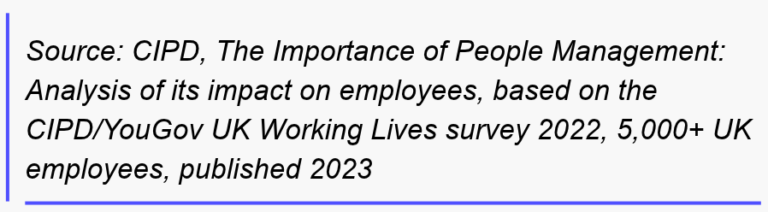
The data on this is stark, and it comes from one of the largest UK employee surveys available. CIPD’s Importance of People Management report, based on the CIPD/YouGov UK Working Lives survey of over 5,000 UK employees, found that among those with a very poor relationship with their line manager, 45% thought it likely or very likely that they would quit their job in the coming year, compared with just 14% of those who described a very good relationship. That’s not a marginal difference in retention risk, it’s more than three times the likelihood of leaving, and it sits entirely on the quality of one relationship: the one with the person managing them day to day.
This is where the first three patterns converge. A manager who avoids the conversation that needs having, who won’t delegate, and who doesn’t notice when someone on their team is struggling, isn’t failing in three unrelated ways. They’re failing in one way, consistently, across every situation that calls for the skills nobody taught them. The team feels the accumulation of that even when they couldn’t name any single incident that caused it. And the outcome, when it’s left unaddressed, is rarely a gradual decline. It’s a resignation letter that seems to come out of nowhere to the manager, and inevitable to everyone who saw it coming.
Closing the gap
None of the four patterns above are failures of character. They’re what happens when someone capable is handed a role built on people skills, with no structured way to develop them, and left to work it out through trial, error, and whatever example their own manager happened to set. The organisation that promoted them isn’t wrong to have done so, the person deserved the recognition. But recognition and readiness are two different things, and treating them as the same thing is where the pattern begins.
We’ve written before about what this costs at scale, the productivity, the attrition, the accumulated drag of decisions made by people who were never equipped to make them well. This piece has tried to make that pattern recognisable at the level of a single team, a single manager, a single conversation avoided or task not delegated. If any of the four rang true against someone in your organisation, the good news is that none of them are fixed traits. They’re gaps, and gaps close with the right training, applied consistently, at the point in someone’s career when it will actually make a difference.

That is why every Aicura programme combines the same four elements: executive coaching to build confidence and judgement, structured leadership development, a live workplace project tested on a real organisational problem, and a recognised qualification. All four exist for one outcome: measurable business impact, not simply completion of a course.
That impact rarely stops with one person. As individuals grow into more capable leaders, through coaching that builds self-awareness, interpersonal skill, and emotional intelligence alongside technical and strategic capability, that growth moves outward: into how they lead their team, and into what the organisation is able to achieve as a result. For us, Aicura has always been built around one belief: developing people first, because it is people, not tools or subject matter, that determine whether change actually happens inside an organisation. Every programme we deliver, whether it is a CMI-accredited leadership qualification, a management apprenticeship, or a programme that introduces AI and automation into the workplace, sits inside that same philosophy. We treat every subject as a leadership challenge rather than a stand-alone technical skill to be taught in isolation.
Individual growth, stronger leadership, and organisational change are one connected outcome, not three separate ones, and it is the outcome every programme is built around.
We build relationships with the individuals on our programmes and the organisations that sponsor them, take the time to understand each organisation’s context, and stay close throughout the journey rather than stepping back once a programme has been delivered. Some of our longest relationships now span several years and multiple cohorts, evidence that this is a genuine partnership rather than a one-off engagement. Our aim is to become a genuine development partner to the organisations we work with, not a training provider that disappears once a course ends.
Subjects, tools, and technologies will keep changing: today it is AI and automation, tomorrow it will be something else. What endures is the capability we build in people: the ability to make good decisions, bring others with them, and turn new capability into outcomes that matter, whatever that capability happens to be. As the pace of change accelerates, in AI as in every other area, that human element becomes more important, not less. That is what developing people first has always meant at Aicura, and it is the constant behind every programme we run.
Details of Aicura’s full CMI programme, ranging from Level 3 to Level 7.
