
12 Aug AI won’t lead itself
Why the organisations that win with AI are led, not just equipped
Every organisation now has access to the same AI. The same models, the same tools, the same pace of release. A capability that felt rare 18 months ago is now a monthly subscription anyone can hold.
Access to the technology no longer separates the leaders from the rest. Knowing where to point it does.
AI provides the tools. Leadership decides whether those tools create real value.
The AI Tool Trap
There is a comfortable assumption doing the rounds: buy the technology and the results will follow. They rarely do. Most organisations now have a drawer full of AI: a few licences here, a chatbot there, a pilot that impressed everyone in the demo and then quietly stalled. Activity went up. Outcomes didn’t move.
That is the trap. AI doesn’t create competitive advantage; leaders do. A model can draft, summarise, analyse and automate quickly, but speed on the wrong thing is just expensive motion. A tool pointed at a problem nobody agreed was worth solving simply produces faster versions of work that shouldn’t have been done at all. Left to itself, AI accelerates activity. It takes leadership to turn that activity into better business outcomes, and to decide which activity was worth accelerating in the first place.
Adoption isn't the hard part
Most organisations can adopt AI. Plenty already have. The harder task is alignment: connecting AI to strategy, to how decisions get made, and to how work actually gets done.
Alignment is unglamorous work. It means being honest about what the organisation is really trying to achieve, then choosing the handful of places where AI would make a measurable difference rather than the dozens where it merely looks impressive. It means building the capability to act alongside the enthusiasm to start. And it means clear accountability: someone who owns the outcome, signs off the risk, and answers for the result when it lands in front of a customer.
Get clarity, capability, and accountability wrong, and AI becomes a scattering of clever pilots that never add up to much. Get them right and it becomes a catalyst for real, lasting change and sustainable performance. The difference between the two is rarely the technology; it is almost always the leadership around it.
What leadership actually does

Strip away the hype and the leadership job around AI is specific and demanding. It means spotting the problem that is genuinely worth solving, not the one that is easiest to automate. It means building a credible case and getting the people who hold the budget to back it. It means owning the governance: the data, the risk, the ethics, and the question of what happens when the model gets it wrong. And it means taking colleagues through the change, because a brilliant workflow nobody trusts or uses has changed nothing.
Those are judgement, communication and nerve, applied to a fast-moving technology, rather than a technical skillset.
It is the ability to stand in front of a board and explain what the tool does, why it matters, what it costs, what could go wrong, and how you will know it worked.
Those are leadership capabilities, and like any leadership capability, they can be developed deliberately in the people who already understand how the organisation runs.
Who leads the next decade
The organisations that lead the next decade will be defined less by their technology and more by the leaders who can align strategy, commercial execution, pricing, data, and AI around measurable business outcomes, and hold their nerve while doing it.
That capability doesn’t arrive with a software licence, and it is difficult to hire at the pace the market is moving. The more sustainable route is to grow it from within: to take capable people who understand the operation, the customers, and the numbers, and give them the leadership skills to put AI to work responsibly. That is a deliberate investment, and it compounds.
Building the bridge
This is the gap the Aicura AI and Automation Practitioner apprenticeship is built to close. It develops the people who can sit between the technology and the strategy, and lead the connection between the two.
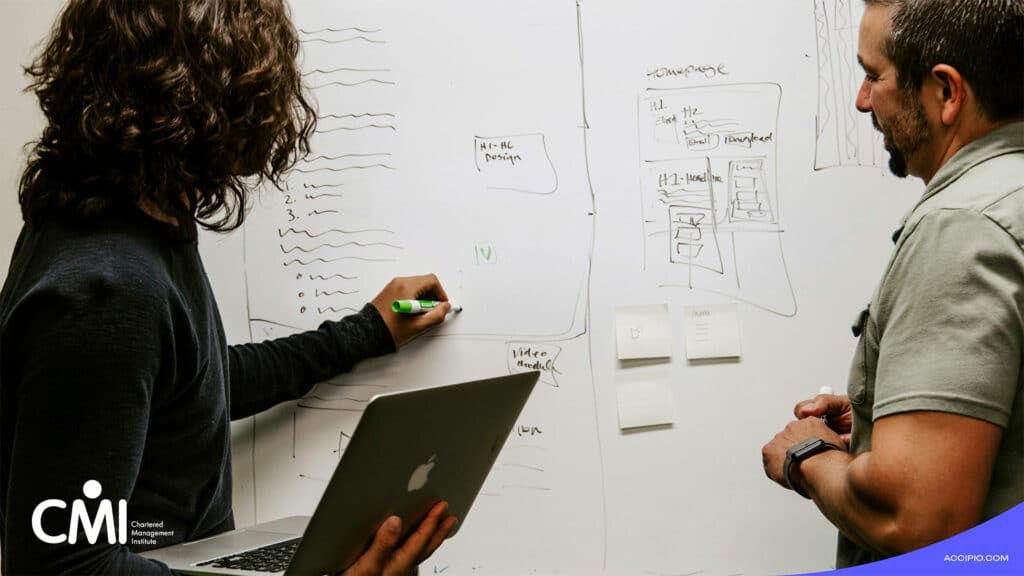
Over 18 months, each apprentice takes a real problem in their own organisation and leads it from opportunity to measurable result. They identify what is worth changing, build the business case, design and test what they build, own the governance and risk, take colleagues through the adoption, and prove the value at the end. It is a live piece of work rather than a written case study, and the improvement stays with the employer when the programme finishes.
Leadership runs through all of it. Every apprentice has a leadership coach, an executive sponsor inside their organisation, and regular live leadership sessions, so they build the judgement to make the call as well as the skill to configure the tool. They finish with two qualifications: the Level 4 apprenticeship (ST1512) and an embedded CMI Level 5 Certificate in Management and Leadership.
No coding background is needed. The programme is aimed squarely at people in operations, improvement, transformation, and digital change who are expected to lead as well as build. It is funded through the apprenticeship levy, with government co-funding available for smaller employers who don’t pay into the levy, so organisations can grow these leaders rather than pay a premium to recruit them.
Why Aicura
Aicura has always been built around one belief: developing people first, because it is people, not tools or subject matter, that determine whether change actually happens inside an organisation. Every programme we deliver, whether it is a CMI-accredited leadership qualification, a management apprenticeship, or a programme that introduces AI and automation into the workplace, sits inside that same philosophy. We treat every subject as a leadership challenge rather than a stand-alone technical skill to be taught in isolation.
That is why every Aicura programme combines the same four elements: executive coaching to build confidence and judgement, structured leadership development, a live workplace project tested on a real organisational problem, and a recognised qualification. All four exist for one outcome: measurable business impact, not simply completion of a course.
That impact rarely stops with one person. As individuals grow into more capable leaders, through coaching that builds self-awareness, interpersonal skill, and emotional intelligence alongside technical and strategic capability, that growth moves outward: into how they lead their team, and into what the organisation is able to achieve as a result. For us, individual growth, stronger leadership, and organisational change are one connected outcome, not three separate ones, and it is the outcome every programme is built around.
We build relationships with the individuals on our programmes and the organisations that sponsor them, take the time to understand each organisation’s context, and stay close throughout the journey rather than stepping back once a programme has been delivered. Some of our longest relationships now span several years and multiple cohorts, evidence that this is a genuine partnership rather than a one-off engagement. Our aim is to become a genuine development partner to the organisations we work with, not a training provider that disappears once a course ends.
Subjects, tools, and technologies will keep changing: today it is AI and automation, tomorrow it will be something else. What endures is the capability we build in people: the ability to make good decisions, bring others with them, and turn new capability into outcomes that matter, whatever that capability happens to be. As the pace of change accelerates, in AI as in every other area, that human element becomes more important, not less. That is what developing people first has always meant at Aicura, and it is the constant behind every programme we run.
The Key Point
AI is no longer the hard part. Leadership is. The technology will keep arriving on its own, month after month, whether or not anyone is ready for it. The leadership has to be built. That is the bridge between AI and real business value: the ability to align strategy, people, and technology around outcomes that can be measured. It is exactly what this programme sets out to build.
Explore the AI and Automation Practitioner apprenticeship, or get in touch to talk through a cohort for your organisation