

14 May Management Training for New Managers: What to Include and When to Start

The most common time to commission management training for a newly promoted manager is several months after the promotion, once the gaps have become visible. By then, the manager has already formed habits, some useful, some not, and the team has already calibrated its expectations of them. Changing both is harder than establishing them well in the first place.
If you’re an L&D Director or HR leader who is thinking about when and how to intervene in the new manager transition, this post covers: what management training for new managers should actually include, why the timing of that intervention matters more than most organisations acknowledge, and how a structured development programme differs from the onboarding and line manager support that typically fills the gap.
The short version: the window is earlier than most organisations act, the content is more specific than most training covers, and the investment pays back differently when it precedes bad habits rather than correcting them.
Why the first 90 days matter disproportionately

The transition into management is not a gradual shift. It is an identity change. The person who was recognised and rewarded for individual contribution is now responsible for the contribution of others, and the skills that made them successful in their previous role are at best insufficient and at worst actively counterproductive in the new one.
Research consistently shows that this transition is where management capability is most vulnerable. The habits formed in the first weeks and months of a management role tend to persist, because they become the baseline from which the manager and their team operate. A new manager who establishes a pattern of avoiding difficult conversations, micromanaging delivery, or failing to develop their team members will typically continue those patterns unless something intervenes to change them. And that intervention becomes progressively more difficult as time passes.
The scale of the risk is significant. Around 60% of new managers in the UK are estimated to fail within their first year, due to a combination of inadequate training, high pressure, and lack of structured support. That failure rate represents a direct cost to the organisation in recruitment, team disruption, and lost productivity, and quite apart from the impact on the individuals involved.
The implication for L&D Directors is that the timing of development investment is not a scheduling question. It is a strategic one. An organisation that waits for the gaps to become visible before commissioning development has already paid a cost that earlier intervention would have avoided.
What most new manager onboarding does not cover
Most organisations have some form of new manager onboarding. It typically covers the administrative and process dimensions of the role: how to conduct a performance review, how to manage a probationary period, and what the organisation’s policies are on absence and disciplinary procedures. This content is necessary, but it is not development.
What it does not cover, and this is what new managers most consistently report needing, is the interpersonal and leadership dimension of the role: how to establish credibility with a team as a peer-turned-manager, how to have honest conversations about performance without damaging relationships, how to make decisions confidently when the answer is not clear, and how to manage the emotional demands of being responsible for other people’s working lives.

These are not soft skills in the pejorative sense. They are the primary determinants of management effectiveness, and they are the areas where the gap between what organisations provide and what new managers need is widest. CMI research found that 82% of managers enter management roles without formal training in these areas, the accidental manager problem that shapes the early experience of most newly promoted managers.
The distinction between onboarding and development matters because they require different things from a provider. Onboarding can be delivered through internal resources and process documentation. Development requires external expertise, structured content, and assessment. And it requires a framework that goes beyond the organisation’s own view of what good management looks like.
What management training for new managers should include
Effective management training at the new manager stage needs to cover six areas. These are not discrete modules to be delivered and ticked off. They are interconnected capabilities that develop in parallel and reinforce each other. The best programmes treat them as an integrated curriculum rather than a sequential checklist.
Self-awareness and personal effectiveness.
Before a new manager can lead others, they need an accurate understanding of how they come across, what their default behaviours are under pressure, and where their instinctive responses are likely to create problems. Tools like DiSC profiling and 360-degree feedback are useful here, but only when they are embedded in a development process rather than administered as a standalone event. The goal is not a personality insight but a practical change in how the manager monitors and adjusts their own behaviour.
Understanding and developing others.
New managers frequently underestimate the diversity of motivations, working styles, and development needs in their team. Management training should give them a structured approach to understanding individual team members, identifying what each person needs to perform well, and creating the conditions for that performance. This is distinct from the HR process as this is the day-to-day practice of management that determines whether a team functions well or poorly.
Having difficult conversations.
The avoidance of difficult conversations is one of the most consistent failure modes in new managers. Performance issues go unaddressed, misalignments persist, and resentments accumulate because the manager lacks either the framework or the confidence to raise the issue directly. Effective training builds both a clear structure for performance conversations and the practice environment to develop the confidence to use it.
Decision-making and problem-solving.
New managers often find the shift from individual problem-solving to collective decision-making disorienting. They are used to arriving at answers themselves; management requires them to involve others in reaching conclusions, to make decisions with incomplete information, and to own outcomes that depend on people they do not fully control. Training should address the specific challenges of management-level decision-making, not generic problem-solving frameworks.
Operational management and planning.
The practical mechanics of managing a team, such as workload planning, resource allocation, managing competing priorities, and reporting upwards. These are rarely taught explicitly and are frequently the source of early management difficulties. New managers can greatly benefit from a structured approach to operational management that gives them tools they can use immediately, rather than learning through trial and error.
Talent identification and development.
One of the most important and most often neglected aspects of new manager development is the ability to identify, develop, and retain the talent within their team. This includes recognising potential in individuals who may not be the most immediately productive, creating development opportunities within the team’s day-to-day work, and understanding what motivates different people to stay and grow. Talent management capability, embedded in management training from the outset, builds organisational resilience in ways that become visible over time rather than immediately, which is precisely why it tends to be deprioritised in favour of more immediately pressing development needs.
The case for formal qualification over informal development
There is a view in some organisations that new manager development is best served by good line management support, peer learning, and on-the-job experience, rather than formal qualification. That view is not entirely wrong because experience and peer learning are genuinely valuable. But it misses three things that a formal qualification provides.

First, a structured framework that covers the full breadth of management capability at this career stage, not only the areas the manager encounters in their specific role. An eCommerce manager and a clinical team leader will face different day-to-day challenges, but they share a common set of management capability requirements. A CMI Level 3 programme covers those requirements systematically, regardless of sector.

Second, external assessment. A manager who has completed a CMI Level 3 Diploma has been assessed against a nationally regulated standard. That assessment matters for the individual (it requires them to demonstrate their capability rather than simply attend) and for the organisation, which gains an externally verified marker of development rather than an internally evaluated one.

Third, a career-long credential. The CMI qualification stays with the individual through their career, accumulating value as they progress. A CMI Level 3 Diploma is the foundation of a development pathway that runs through Level 5 for middle managers, Level 6 for senior managers, and Level 7 for senior leaders, all leading to Chartered Manager status. An organisation that starts new managers on a formal CMI pathway is not just addressing the immediate development need; it is making the first investment in a career-long development architecture.
When to start and how to structure the investment
The question of timing has a clearer answer than most organisations assume: the earlier the better, subject to the manager having enough context in their new role to make the programme content meaningful. A manager who enters a CMI Level 3 programme before they have had any management experience will struggle to connect the learning to their practice. A manager who enters six months into the role may already have formed the habits the programme is designed to prevent.
The practical answer for most organisations is a structured onboarding period of four to eight weeks, which gives enough time for the manager to understand their team and their remit, followed by enrolment in a formal development programme. For organisations with rolling cohort starts, this is achievable without significant coordination overhead.
The structure of the programme itself should reflect the reality of a new manager’s working life: online delivery, flexible scheduling, and a time commitment that is demanding but sustainable alongside a full management role. A CMI Level 3 Diploma typically requires around four to six hours of study per week over twelve to eighteen months. Significant, but manageable when the programme is well designed, and the manager understands what they are working towards.
For organisations commissioning development for multiple new managers simultaneously, a closed-cohort approach allows the programme to be contextualised to the organisation’s specific management challenges and culture. This is particularly valuable where new managers share a common organisational context (the same sector, the same strategic pressures, the same team dynamics) that a generic open programme cannot fully address. Where bespoke development is needed, programmes can be designed around the organisation’s specific needs, with talent management, culture development, and other organisational priorities woven into the curriculum.

How Aicura supports new manager development
Most management training focuses on what a manager does. Aicura’s programmes focus on who a manager is becoming.
That distinction matters at every career stage, but it matters most at the beginning. A new manager is not simply acquiring a set of skills – they are forming a professional identity: a sense of who they are as a leader, what they stand for, and what kind of culture they want to build around them. The habits, values, and relationships they establish in their first months of management will shape the experience of every person they lead from that point forward. That is a significant responsibility, and it deserves to be taken seriously from day one.
Aicura’s CMI programmes are built around exactly this understanding. Every learner is assigned a personal skills coach, someone who works with them not just on assignment support and qualification progress, but on their individual leadership journey: the story behind the person, the experiences that have shaped their instincts, and the legacy they want to create in the teams and organisations they lead. This is not a pastoral add-on. It is central to how development works at Aicura, and it is what distinguishes a qualification from a transformation.
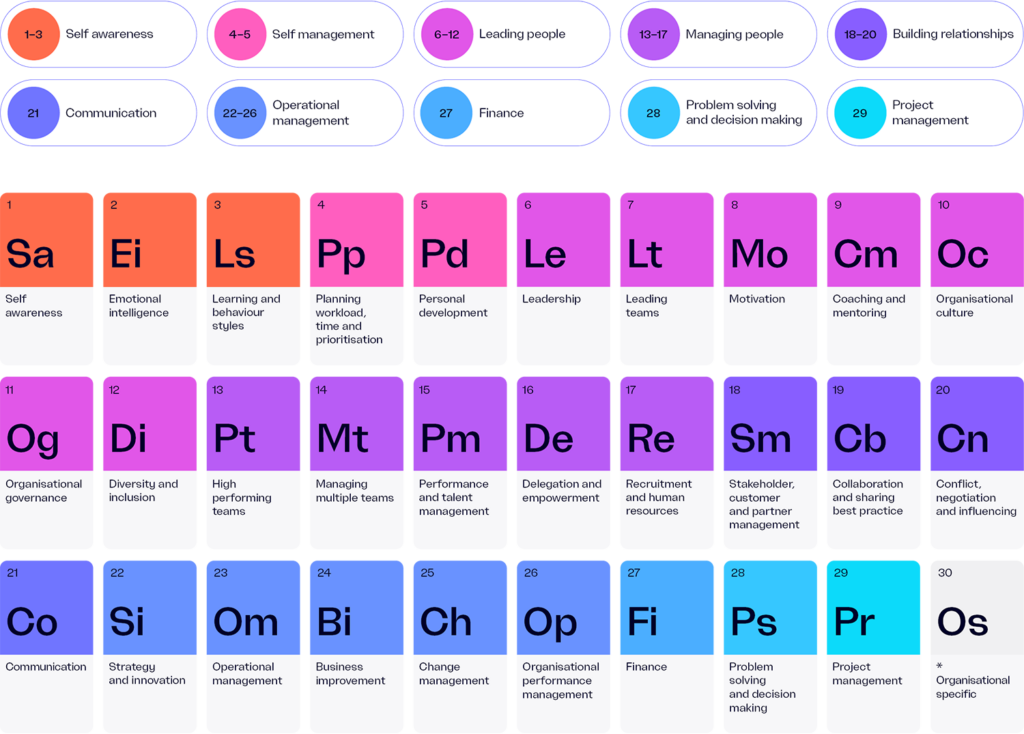
The C30 framework, which structures all Aicura programmes, maps the 30 capabilities that effective managers and leaders need to develop across their careers. It gives each learner a clear picture of where they are, where they need to grow, and how their development is connecting to the kind of leader they are working to become. Support and challenge are built into every stage of the programme, meaning that learners are not simply encouraged; they are stretched, and they are helped to understand why that stretch matters for the people who will follow them.
For learners who want to go further, completing a CMI apprenticeship with Aicura opens the door to additional CMI Awards in specialist subject areas alongside the core programme — a practical way to build depth in the areas most relevant to the individual’s role, sector, or ambitions without stepping outside a coherent development architecture.
Open programme enrolments run on a rolling basis, so organisations can start new managers on this journey within weeks of promotion. For organisations with sufficient numbers, closed-cohort delivery allows the programme to be grounded in the specific culture, challenges, and strategic context of the organisation — giving learners the opportunity to develop together, and to begin shaping the shared culture they will carry forward.
Increasingly, organisations come to us not with a qualification level in mind, but with a specific challenge: a leadership pipeline that is not developing fast enough, a culture shift that requires a new kind of management capability, or a workforce change that demands something the standard programme catalogue does not cover. In those situations, we design a bespoke programme around the need rather than simply the qualifications being sought. The CMI qualification framework provides the assessed, externally verified structure; the programme design, content, and delivery are shaped to meet the organisation’s specific context.